Quick answer: HSS can suit occasional or low-volume work, cobalt HSS is often a practical balance for general stainless-steel drilling, and solid carbide is best evaluated on rigid CNC equipment with low runout and reliable coolant. The correct choice still depends on the stainless grade, hole depth, geometry, cooling, and production requirements.
Choosing drill bits for stainless steel is a process decision, not simply a hardness decision. A drill that performs well in 304 stainless steel may not be the best choice for a deep hole in 316, a heat-treated 17-4 PH component, or a high-volume CNC line. Material grade, hole depth, machine rigidity, tool runout, drill geometry, coating, coolant, and chip evacuation all interact.
This CNC buyer’s guide explains how to select a practical drilling solution for stainless steel. It compares HSS, cobalt HSS, and solid carbide; explains geometry and coating choices; covers shallow and deep holes; and provides a troubleshooting and purchasing checklist for manufacturers, distributors, and OEM buyers.
When a stainless-steel component also requires finishing or related milling operations, the same process-based approach can be extended to CNC end mills.
Why Stainless Steel Is Difficult to Drill
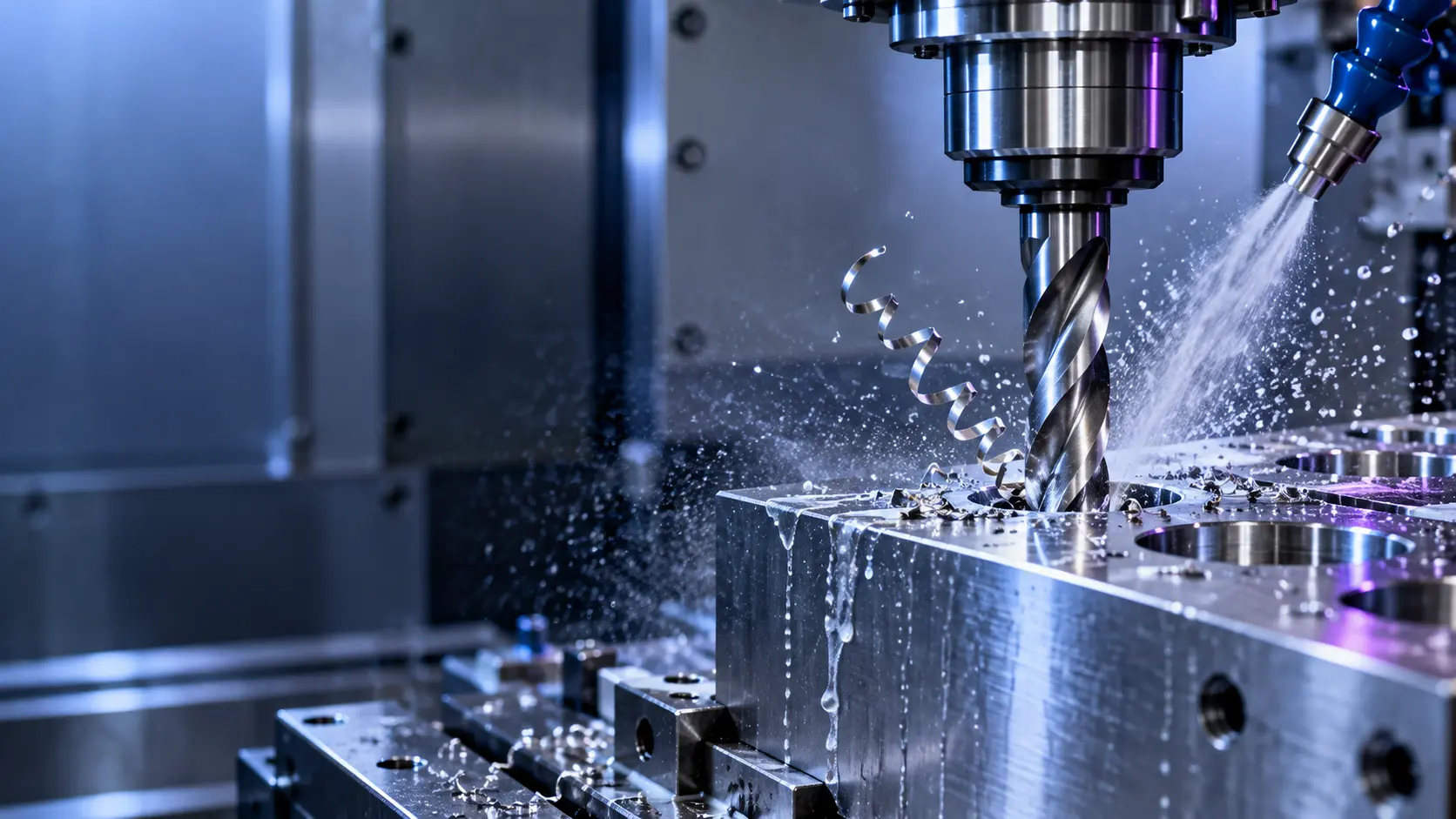
Stainless steel is a family of alloys rather than one uniform material. Its alloy content, microstructure, hardness, and heat-treatment condition can change cutting behavior significantly. Compared with free-machining steels, many stainless grades create more heat at the cutting edge, produce long or sticky chips, and are less forgiving of an unstable setup.
Work hardening
Some stainless steels harden when the cutting edge rubs instead of shearing cleanly. Dwell, an overly light feed, a blunt edge, tool deflection, or repeated passes over the same surface can create a harder layer in front of the drill. The next cutting edge then works against a more difficult surface, increasing heat and edge wear. A sharp, properly supported drill and a continuous, effective cutting action are therefore important.
Heat Retention and Chip Evacuation
Stainless steel can retain heat near the hole, while its ductile chips may wrap around the drill. Poor chip evacuation increases friction and can block coolant from reaching the cutting zone. The result may be discoloration, a rough hole, edge chipping, or sudden drill breakage.
Rigidity and runout
Solid carbide drills can offer high stiffness and accuracy potential, but they are less tolerant of vibration, interrupted cutting, excessive runout, and weak clamping than tougher HSS tools. Before changing tool material, check the holder, spindle, workholding, tool extension, and machine condition.
Identify the Stainless Steel Grade First
Confirm the material grade and condition before selecting drill bits for stainless steel. The same nominal grade can behave differently after cold work or heat treatment.
- Austenitic grades such as 304 and 316: commonly require careful control of heat, rubbing, and long chips. Their corrosion resistance does not make them easy to drill.
- Martensitic stainless steel: hardness and heat-treatment condition can increase cutting forces and wear. Verify the actual hardness instead of relying only on the grade name.
- 17-4 PH stainless steel: precipitation-hardening condition can substantially change machinability. H900, H1150, and other conditions should not be treated as interchangeable.
- Duplex stainless steel: its mixed structure can create demanding cutting conditions. Stable clamping, suitable geometry, and controlled heat are especially important.
For a production recommendation, record the grade, hardness or heat-treatment condition, hole diameter, tolerance, depth, and whether the hole is blind or through.
HSS vs. Cobalt vs. Solid Carbide Drill Bits
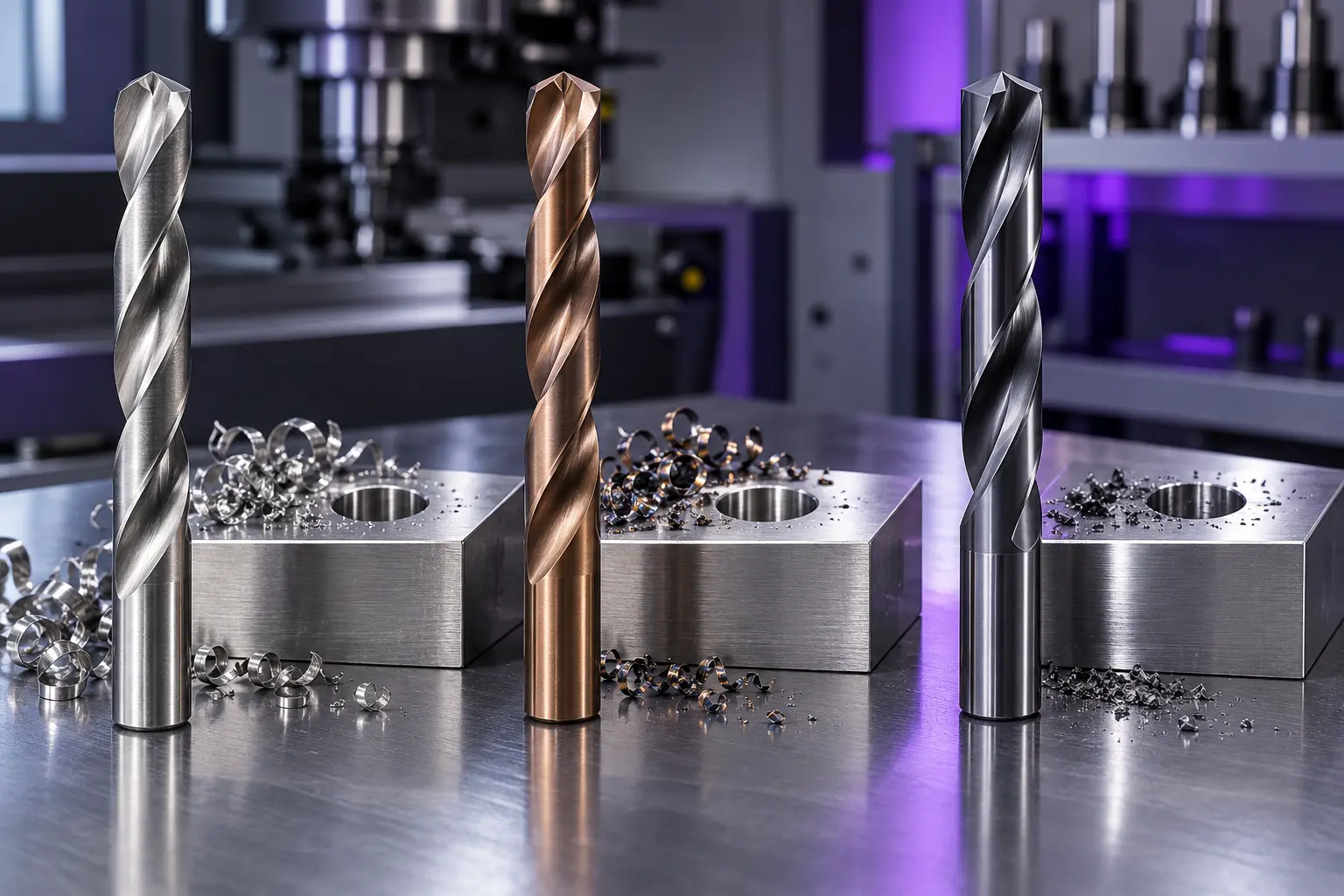
No single drill material is best for every stainless-steel operation. Use the following comparison as a starting point, then validate the choice under the actual machine and coolant conditions.
| Drill material | Suitable applications | Main strengths | Limitations |
|---|---|---|---|
| HSS | Occasional, low-volume, or less rigid applications where toughness and flexibility matter more than maximum productivity | Good toughness, accessible cost, and broad availability | Lower hot hardness and wear resistance than cobalt or carbide |
| Cobalt HSS | General stainless-steel work and medium-duty production | Useful balance of toughness and resistance to heat-related wear | Still depends on correct geometry, cooling, and chip evacuation |
| Solid carbide | Rigid CNC machines, repeat production, and accuracy-focused work | High stiffness and wear resistance potential | More sensitive to vibration, runout, interrupted cuts, and poor clamping |
When HSS is practical
HSS can be a reasonable choice for occasional holes, manual or lower-speed work, and machines where impact toughness matters more than maximum productivity. It is not a substitute for proper cutting practice: rubbing and overheating can damage an HSS drill quickly.
When cobalt HSS is a balanced option
Cobalt HSS is often considered when stainless steel generates more heat than ordinary HSS can comfortably handle, but the setup still benefits from toughness. It may suit some general 304 or 316 applications when the hole size, depth, machine rigidity, coolant, and production requirements are compatible.
When solid carbide makes sense
Solid carbide is worth evaluating when the CNC machine, holder, and workholding are rigid and repeatable. It can be appropriate for production drilling and smaller diameters where stiffness is valuable. If the machine has excessive runout or vibration, solve that problem before moving to carbide.
Choose the Right Drill Geometry
Geometry determines how the drill enters the material, forms chips, and carries heat away. A suitable substrate with unsuitable geometry can still produce poor results.
- Point design: a split or self-centering point can reduce walking and help stabilize entry. The best point form depends on diameter, surface condition, and machine rigidity.
- Point angle: a larger or smaller angle changes thrust, edge support, and entry behavior. Do not apply one angle to every stainless grade and hole type.
- Helix and flute shape: these affect chip lifting, chip space, and coolant access. Ductile stainless chips need a flute design that supports reliable evacuation.
- Web thickness: a stronger web improves resistance to deflection, but excessive core thickness can reduce chip space and increase thrust.
- Margin and edge preparation: the margin supports the hole wall, while edge honing or preparation can improve chipping resistance. Too much edge preparation may increase cutting force.
For a custom recommendation, provide a sample hole, drawing, or current failure photo when possible. Geometry should be chosen together with material, diameter, depth, and machine conditions.
Select a Suitable Drill Coating
A coating may reduce friction, adhesion, and wear, but it cannot correct a blunt geometry, unstable holder, poor coolant delivery, or incorrect cutting action. Coating selection should match the drill substrate and the actual stainless-steel operation.
Common coating families used in cutting-tool discussions include TiN, TiCN, TiAlN or AlTiN, and AlCrN. Their behavior depends on layer design, temperature capability, surface condition, and the tool underneath. A coating chosen for dry or high-temperature work may not be the best answer for every wet, low-speed, or interrupted operation.
Ask the supplier to confirm the intended material group, speed range, coolant method, and hole depth before treating a coating as a universal solution.
Select Drill Bits by Hole Depth and Diameter
Hole depth is commonly discussed as a multiple of drill diameter, written as ×D. Approximately 3×D and 5×D are useful reference points, not universal limits. The practical limit depends on drill design, diameter, grade, machine, coolant, and chip evacuation.
Shallow holes: around 3×D or less
Many shallow holes can be handled with a standard geometry when the workpiece is secure and chips can exit freely. Check entry stability and avoid allowing chips to pack at the bottom of a blind hole.
Medium-depth holes: around 5×D
At greater depth, chip evacuation and coolant access become more important. A longer drill should not simply be used with the same setup. Verify runout, tool extension, flute capacity, and the machine’s ability to deliver coolant into the hole.
Deep holes beyond 5×D
Deep-hole work may require a dedicated long-reach design, internal coolant, pecking or controlled withdrawal, and a process designed to prevent chip packing. The correct strategy depends on whether the hole is blind or through and on the required straightness and tolerance.
External Coolant vs. Internal Coolant
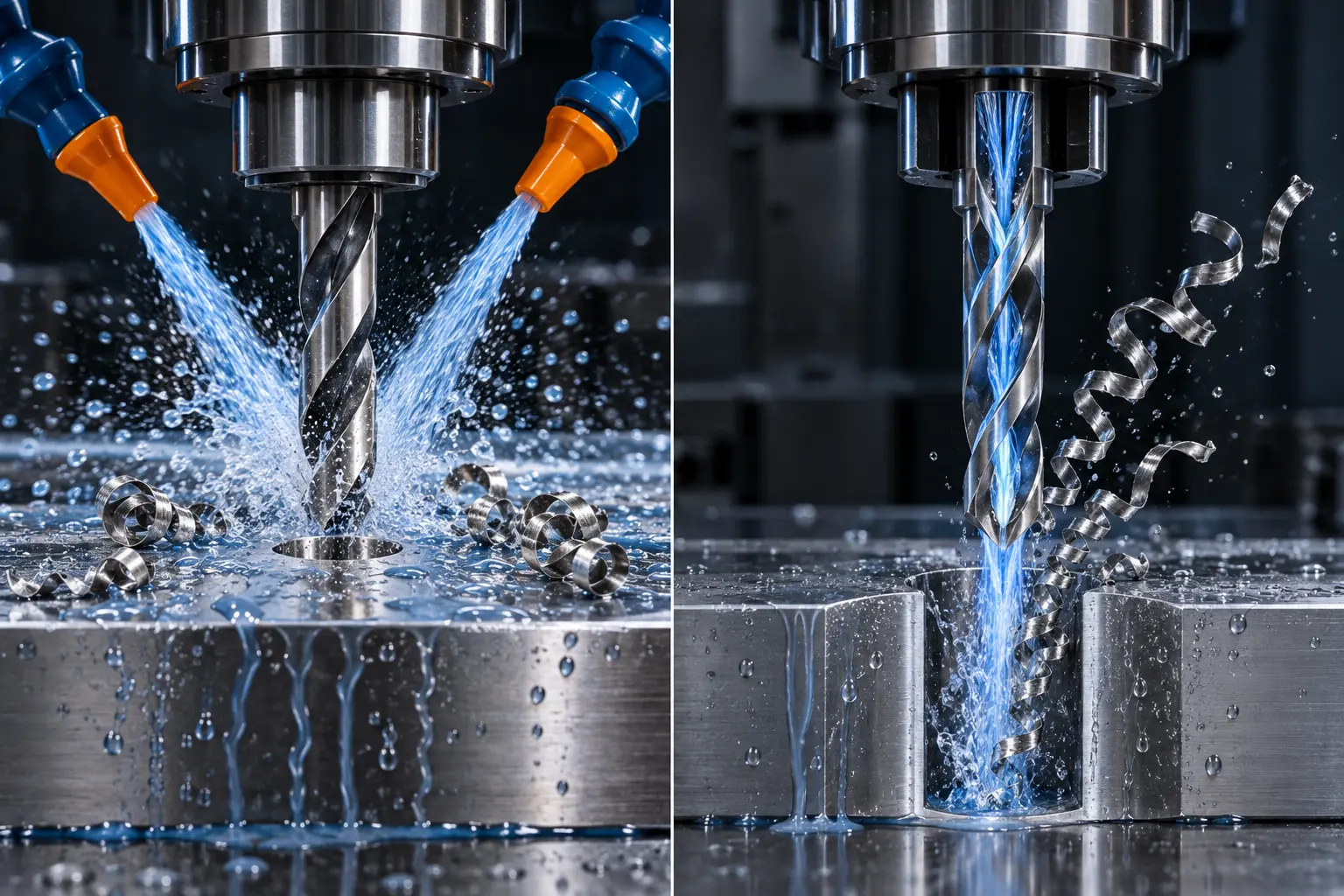
External coolant can be adequate for some shallow holes when the flute carries chips out cleanly. It becomes less reliable as the hole gets deeper or the chips become longer and more adhesive.
Internal coolant can deliver fluid closer to the cutting zone and help carry chips out of a deeper hole. It requires a compatible tool, clean coolant, suitable pressure and flow, and a machine capable of supporting the system. A through-coolant drill is not automatically effective if filters are blocked or the tool is not sealed correctly.
When comparing the two methods, review coolant direction, concentration, filtration, pressure, flow, hole depth, and chip shape together. Validate any cutting data with a controlled test rather than transferring numbers from an unrelated tool series.
CNC Setup and Cutting Practices
- Confirm the material: record grade, hardness, and heat-treatment condition.
- Minimize extension: use the shortest practical tool length while allowing access to the hole.
- Check runout: inspect the holder, collet or chuck, spindle, and drill shank.
- Secure the workpiece: eliminate movement, vibration, and unsupported thin sections.
- Avoid dwell: a stationary or rubbing tool can initiate work hardening.
- Form a real chip: validate feed and speed with the tool supplier and monitor chip shape.
- Protect chip evacuation: stop chip packing before it damages the edge or hole wall.
- Record results: track holes per tool, wear location, hole size, coolant condition, and failure mode.
For broader machining operations around the drilled feature, review the available indexable cutting tools alongside the drilling process.
Cutting speed, feed, coolant pressure, and tool-life expectations should be confirmed through supplier data and controlled trials for the specific drill design and machine setup.
Common Stainless Steel Drilling Problems and Fixes
| Problem | Possible causes | Correction direction |
|---|---|---|
| Drill overheats | Rubbing, insufficient coolant, excessive friction, or worn edge | Check effective feed, sharpness, coating, coolant delivery, and tool extension |
| Work hardening | Dwell, light feed, blunt drill, or repeated passes | Prevent rubbing and use a stable cutting action; replace a worn tool |
| Chips wrap around the drill | Long ductile chips, unsuitable flute, or blocked coolant | Review geometry, chip space, coolant direction, and withdrawal strategy |
| Hole is oversized | Runout, vibration, worn margin, or unstable workholding | Measure runout and rigidity before changing only the drill material |
| Cutting edge chips | Impact, interrupted cut, excessive edge load, or carbide vibration | Inspect entry, clamping, edge preparation, and machine stability |
| Drill breaks | Chip packing, excessive deflection, deep-hole overload, or misalignment | Stop the process, remove the cause, and review depth, coolant, and extension |
| Poor surface finish | Worn margin, vibration, unstable feed, or damaged hole wall | Inspect the complete tool and setup rather than polishing over the symptom |
B2B Buyer Checklist for Stainless Steel Drill Bits
Include the following information in an RFQ or technical discussion:
- Stainless-steel grade and hardness or heat-treatment condition;
- Hole diameter, tolerance, and surface-entry condition;
- Blind or through hole and required hole depth;
- Machine type, spindle capability, and tool-holder system;
- Tool extension, runout, and workholding arrangement;
- External or internal coolant, filtration, and available delivery;
- Production quantity and expected changeover frequency;
- Current drill material, geometry, coating, and failure mode;
- Standard tool or custom tool requirement;
- Drawing, CAD, STEP file, sample part, or test-hole information.
If the application requires a special diameter, extended reach, custom coolant design, or non-standard geometry, discuss custom CNC tooling with the supplier before finalizing the purchase.
These details help a supplier evaluate the complete process rather than quote a diameter in isolation. For a matched recommendation, share your material grade, hole size, depth, machine, coolant method, and expected quantity with ZIROO TOOLS.
For a technical review, send the material grade, hardness or heat-treatment condition, hole size, depth, machine type, holder, coolant method, and current failure mode.
Safety Notice
Safety Notice: Inspect drills for cracks, chipped edges, and abnormal wear before use. Secure the drill, holder, fixture, and workpiece correctly. Use machine guarding, eye protection, and other PPE required by your workplace. Never remove chips by hand while the spindle is running; use an appropriate chip hook or tool after the machine has stopped. Confirm clearance, tool length, coolant connections, and withdrawal risks before deep-hole drilling. Make parameter changes through controlled trials and follow the tool maker’s instructions and your site’s machine-safety procedures.
Frequently Asked Questions
1. What is the best drill bit for stainless steel?
There is no universal best drill. Choose HSS, cobalt HSS, or solid carbide according to the stainless grade, hole depth, machine rigidity, production volume, coolant, and required tolerance.
2. Are cobalt drill bits good for stainless steel?
Cobalt HSS can be a practical balance for many general stainless-steel applications because it combines toughness with improved resistance to heat-related wear compared with ordinary HSS. Geometry and setup still matter.
3. Can I use standard HSS drill bits for stainless steel?
Standard HSS can work in suitable low-speed or low-volume applications, but rubbing, overheating, and chip packing can shorten life. Use a suitable stainless-steel geometry and stable cutting practice.
4. Are solid carbide drills suitable for CNC stainless-steel drilling?
They can be suitable on a rigid, well-aligned CNC setup with reliable workholding and coolant. Excessive vibration or runout can cause carbide edge failure, so machine stability must be confirmed first.
5. Why does stainless steel work-harden during drilling?
Work hardening can occur when the drill rubs or dwells instead of cutting. Common triggers include a blunt edge, light effective feed, vibration, poor alignment, and repeated passes through the same surface.
6. What coating is suitable for stainless-steel drill bits?
Coating choice depends on the substrate, geometry, grade, cutting conditions, and coolant. TiN, TiCN, TiAlN/AlTiN, and AlCrN may be considered in different applications, but no coating replaces correct process design.
7. Should I use internal coolant for deep holes?
Internal coolant may improve heat control and chip evacuation in deeper holes, especially with long chips. Confirm that the drill, machine, pressure, flow, filtration, and coolant system are compatible.
8. What information should I provide for a custom stainless-steel drill?
Provide the grade and condition, hole size and tolerance, depth, blind or through-hole status, machine and holder, coolant method, production quantity, current tool, and any drawing or failure information.
Conclusion
Selecting drill bits for stainless steel requires a complete view of the process. Start with the material grade and hole requirements, then match the drill material, geometry, coating, depth capability, coolant, and machine rigidity. If a tool fails, investigate rubbing, heat, chips, runout, clamping, and work hardening before changing one specification at random.
For post-drilling finishing requirements, evaluate carbide reaming tools for precision holes where the application calls for a controlled final hole. Need a drill bit matched to your stainless-steel grade and CNC process? Request a stainless steel drilling tool quote with your hole size, depth, machine type, coolant method, and expected quantity for a technical discussion.