Choosing a CBN end mill for hardened steel involves more than selecting a superhard cutting material. The end profile determines which surfaces the cutter can reach, what corner geometry it leaves, and how it behaves through a finishing path. A square end mill, ball nose end mill, and corner radius end mill solve different geometry problems; none is the right choice for every hardened-steel job.
Use the part drawing and machining stage to guide the choice. A square profile suits flat floors and defined shoulders, a ball nose profile follows continuous 3D contours, and a corner radius profile combines a flat end with a supported cutting corner. This guide compares those profiles and gives CNC buyers, programmers, and tooling distributors a practical selection checklist.
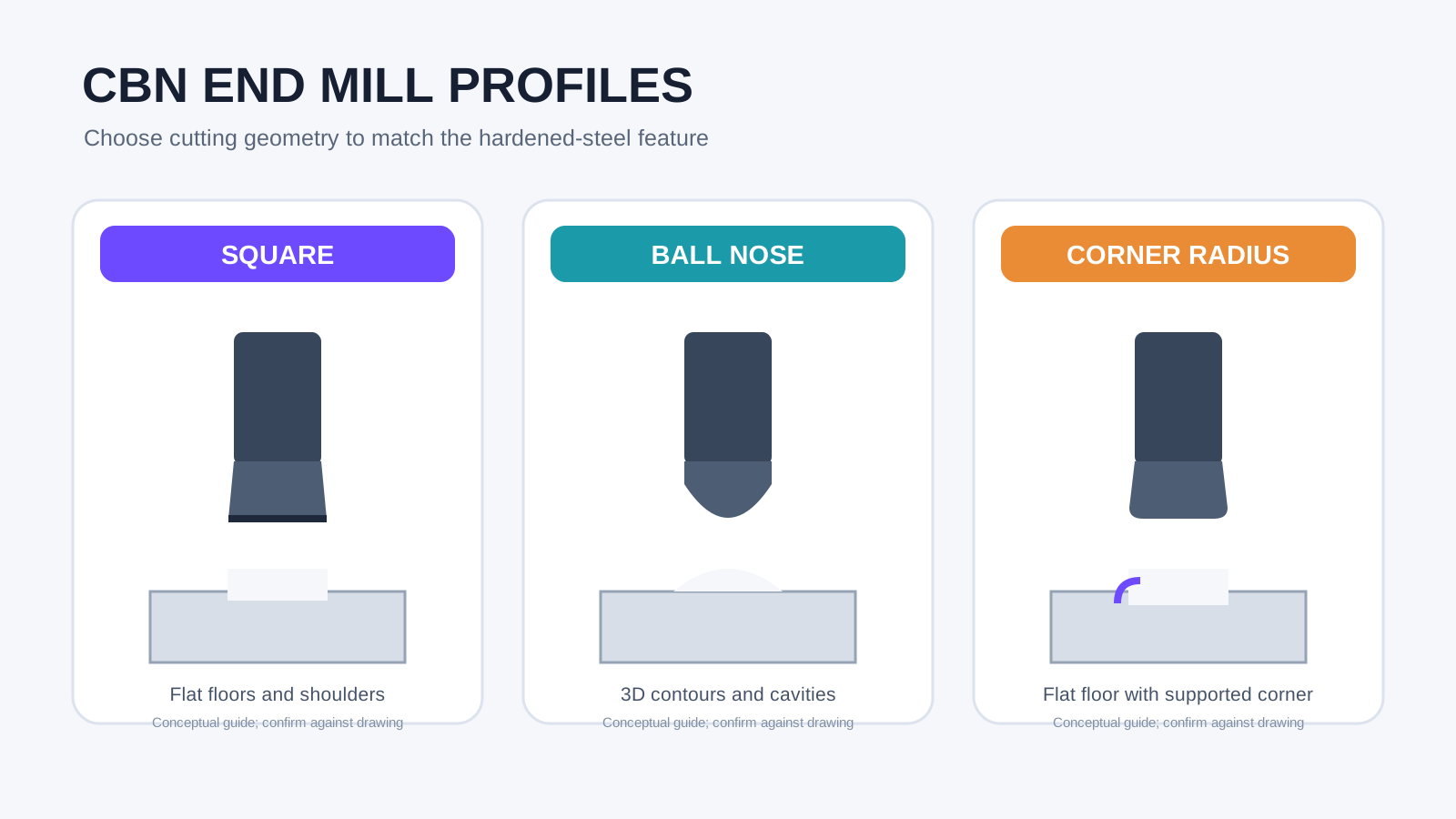
For a CBN end mill for hardened steel, first identify whether the feature needs a sharp internal corner, a controlled fillet, or a continuous 3D surface. Match the profile to that geometry before comparing tool dimensions or cutting conditions.
For a manufacturer reference, review NS Tool’s CBN end mill overview and product information. Treat published conditions as a starting reference only, then validate them for the actual workpiece, tool assembly, and machine.
Quick Comparison: Square vs. Ball Nose vs. Corner Radius CBN End Mills
| Profile | Good fit | Geometry it creates | Key limitation |
|---|---|---|---|
| Square | Flat floors, slots, shoulders, straight walls | Flat end with a nominally sharp corner | Cannot follow continuous 3D contours; the sharp corner may be vulnerable to chipping in an unstable cut |
| Ball nose | 3D contours, cavities, blended and curved surfaces | Spherical end profile | Less suited to broad flat floors; finish depends strongly on toolpath and stepover |
| Corner radius | Flat floors with a specified internal radius, profiles, selected semi-finishing paths | Flat end with a controlled corner radius | Cannot produce a sharp internal corner or every complex 3D surface |
These are geometry distinctions, not guaranteed performance rankings. Results also depend on the actual workpiece condition, tool dimensions, machine and holder rigidity, runout, engagement, toolpath, and the supplier’s application data.
How to Choose a CBN End Mill for Hardened Steel
Hardened steel places demanding conditions on the cutting edge and setup. A cutter profile must reach the required surface while maintaining stable engagement. If the geometry does not match the feature, the process may leave material, create an unwanted radius, require extra tool changes, or produce an inconsistent finish.
Start with the component drawing, not the tool catalogue. Identify flat floors, straight walls, sharp internal corners, radiused transitions, and continuously changing surfaces. Then determine whether the operation is roughing, semi-finishing, or finishing. A geometry that is useful for one stage may be unsuitable for the next.
When to Choose a Square CBN End Mill
A square end mill is a practical profile when the feature requires a flat bottom, straight wall, slot, or shoulder. It can suit hardened-steel details where the tool must preserve a defined edge or reach a nominally sharp internal corner. A CBN end mill for hardened steel with a square profile is worth evaluating when the drawing calls for that flat floor or defined edge.
Check the corner requirement
Confirm the drawing’s internal corner and edge condition. A nominal square tool is not a promise of a perfectly sharp finished corner: the actual result can be affected by edge preparation, tool wear, runout, and the machining strategy. If the drawing specifies a tight corner, make sure the selected tool and finishing plan can achieve it.
Check engagement and stability
Slotting and full-width engagement can create a different load and chip-evacuation situation from light side milling. Confirm the operation, axial depth, radial engagement, tool reach, and machine setup with the tooling supplier. Do not transfer cutting data from a different tool or machine without validation.
When to Choose a Ball Nose CBN End Mill
A ball nose end mill is designed for curved surfaces and continuously changing 3D geometry. It is often considered for hardened mold cavities, blended forms, and contour finishing where a flat end cannot follow the required surface. A CBN end mill for hardened steel with a ball nose profile can follow those changing surfaces, but verify the smallest concave radius and required stepover.
Match the ball profile to the surface
Check the smallest concave radius and the accessible depth. The cutter must reach the surface without the shank or holder colliding with the part. A smaller ball can access tighter details, while a larger, shorter tool may be more rigid where the geometry permits it.
Plan the finishing path
A ball nose cutter leaves a pattern of residual cusps between passes. Stepover, surface curvature, tool inclination, runout, and the CAM strategy affect the resulting finish and cycle time. Set the finish target first, then validate the toolpath and process on the actual machine and material.
When to Choose a Corner Radius CBN End Mill
A corner radius end mill has a flat end with a defined radius where the end and peripheral edges meet. It can be useful when the part needs a flat floor but permits a fillet at the internal corner. The radius also changes the support at the cutting corner, which may be relevant when evaluating edge strength. Choose a CBN end mill for hardened steel with a corner radius only when the specified fillet is allowed by the part drawing.
Do not choose a radius by hardness alone. The radius must fit the part geometry and machining sequence. If it is larger than the smallest internal corner the operation must create, it will leave material. If the geometry requires a continuous sculpted surface, a ball nose tool may be a better fit. A CBN end mill for hardened steel should also have the reach and neck clearance needed for the cavity.
For additional detail on selecting the radius and checking tool access, see the ZIROO TOOLS guide to end mill corner radius for mold machining.
Match the Profile to the Machining Stage
| Stage or feature | Profile to evaluate first | What to verify |
|---|---|---|
| Flat slot, shoulder, or defined edge | Square | Corner requirement, engagement, chip evacuation, reach |
| Broad cavity floor with an allowed fillet | Corner radius | Specified radius, remaining stock, wall access |
| Continuous 3D cavity surface | Ball nose | Minimum concave radius, holder clearance, stepover and finish target |
| Semi-finishing before a dedicated finish pass | Square or corner radius, depending on feature | Uniform stock allowance and access for the next tool |
| Tight local details | Small square, ball nose, or other matched profile | Drawing tolerance, tool reach, deflection and collision risk |
In mold work, a multi-tool sequence may be more suitable than asking one cutter to machine open floors, tight corners, and complex contours. ZIROO TOOLS’ mold machining solution discusses matching tool types to cavity and die features.
Buyer Checklist Before Ordering a CBN End Mill
- Workpiece: Provide the steel grade and heat-treatment condition. State the measured or specified hardness when available.
- Geometry: Share the drawing or CAD model, including the smallest internal radius, floor shape, cavity depth, and tolerance.
- Operation: Identify roughing, semi-finishing, or finishing; describe the toolpath and engagement if known.
- Tool assembly: Confirm diameter, cutting length, reach, neck clearance, holder, and maximum projection.
- Machine and setup: Note machine type, spindle condition, workholding, runout checks, and coolant or air strategy.
- Acceptance criteria: Specify surface-finish and dimensional targets, expected production conditions, and how a trial will be evaluated.
When comparing a CBN end mill for hardened steel, ask the supplier to confirm the intended application and provide recommended starting conditions for your actual setup. A generic hardness label does not establish a safe or productive cutting window.
Common Selection Mistakes
- Choosing by material name alone: “Hardened steel” does not define the feature, hardness condition, engagement, or machine stability.
- Ignoring the required internal radius: A corner radius tool cannot cut a smaller internal radius than its own geometry allows.
- Using a ball nose tool for every surface: A spherical profile may be appropriate for 3D contours but inefficient or geometrically wrong for a broad flat floor.
- Using a square tool for complex contours: A flat-ended profile cannot reproduce a continuously curved surface by itself.
- Overlooking reach and holder clearance: Excessive projection or interference can compromise stability even when the cutting profile is correct.
- Assuming a profile guarantees tool life: Tool life depends on the complete tool-workpiece-machine process and must be assessed under the intended conditions.
For a wider profile overview, read ZIROO TOOLS’ guide to end mill types for CNC machining. If you are comparing substrate, flute design, and coating for different materials, see the carbide end mill selection guide; it covers general selection factors and should not be treated as CBN-specific cutting data.
Frequently Asked Questions
Which CBN end mill profile is best for hardened steel?
There is no single best profile for every job. Choose square for flat floors and defined edges, ball nose for continuous 3D contours, and corner radius when a flat floor with a permitted internal radius is required. Confirm the choice against the part drawing and process conditions.
Can a square CBN end mill machine a hardened-steel cavity?
It can be considered for flat floors, slots, shoulders, and straight walls that its dimensions can reach. Deep or complex cavities may require different profiles or multiple tools. Check access, reach, engagement, and the finishing plan.
When is a ball nose CBN end mill preferable?
Evaluate a ball nose profile for curved, blended, or continuously changing 3D surfaces. Check the smallest concave radius, holder clearance, toolpath, and stepover against the required finish.
Does a corner radius end mill leave a fillet?
Yes. Its corner radius creates a corresponding transition in the machined feature. Verify that the radius is allowed by the drawing and small enough for the internal features the operation must finish.
Can I use the same cutting data for all three profiles?
No. Profile, diameter, reach, engagement, material condition, machine, holder, and toolpath all affect the process. Use supplier guidance for the specific tool and validate the starting conditions in a controlled trial.
What should I send a supplier for a CBN end mill recommendation?
Send the material and heat-treatment condition, drawing or CAD model, smallest internal radius, machining stage, machine and holder details, available reach, toolpath or operation, and surface or dimensional target.
Choose the Profile from the Part, Then Validate the Process
Square, ball nose, and corner radius CBN end mills each solve a distinct geometry problem. Start with the surface and corner requirements, then account for machining stage, reach, holder clearance, machine stability, and finishing allowance. This makes the tool request more precise and helps avoid selecting by product name alone. When specifying a CBN end mill for hardened steel, state the geometry and finish target clearly.
For a project-specific review, send ZIROO TOOLS your drawing and machining details. The appropriate tool geometry and cutting conditions should be confirmed for the actual workpiece and setup.