CNMG vs WNMG Inserts: Key Differences and How to Choose for CNC Turning
Choosing between CNMG and WNMG inserts is not simply a question of which shape has more cutting edges. Both are common negative-rake carbide turning insert families, but they use different shapes, holder systems, and corner arrangements. The wrong choice can lead to a seat mismatch, poor chip control, unstable cutting, or an avoidable trial-and-error purchase.
For most buyers, the correct order is straightforward: confirm the holder first, then define the operation and workpiece material, and only then select the grade, chipbreaker, nose radius, and cutting data. This guide explains the practical CNMG vs WNMG inserts differences so you can prepare a more accurate quotation or test plan.

Quick Answer: CNMG vs WNMG Inserts
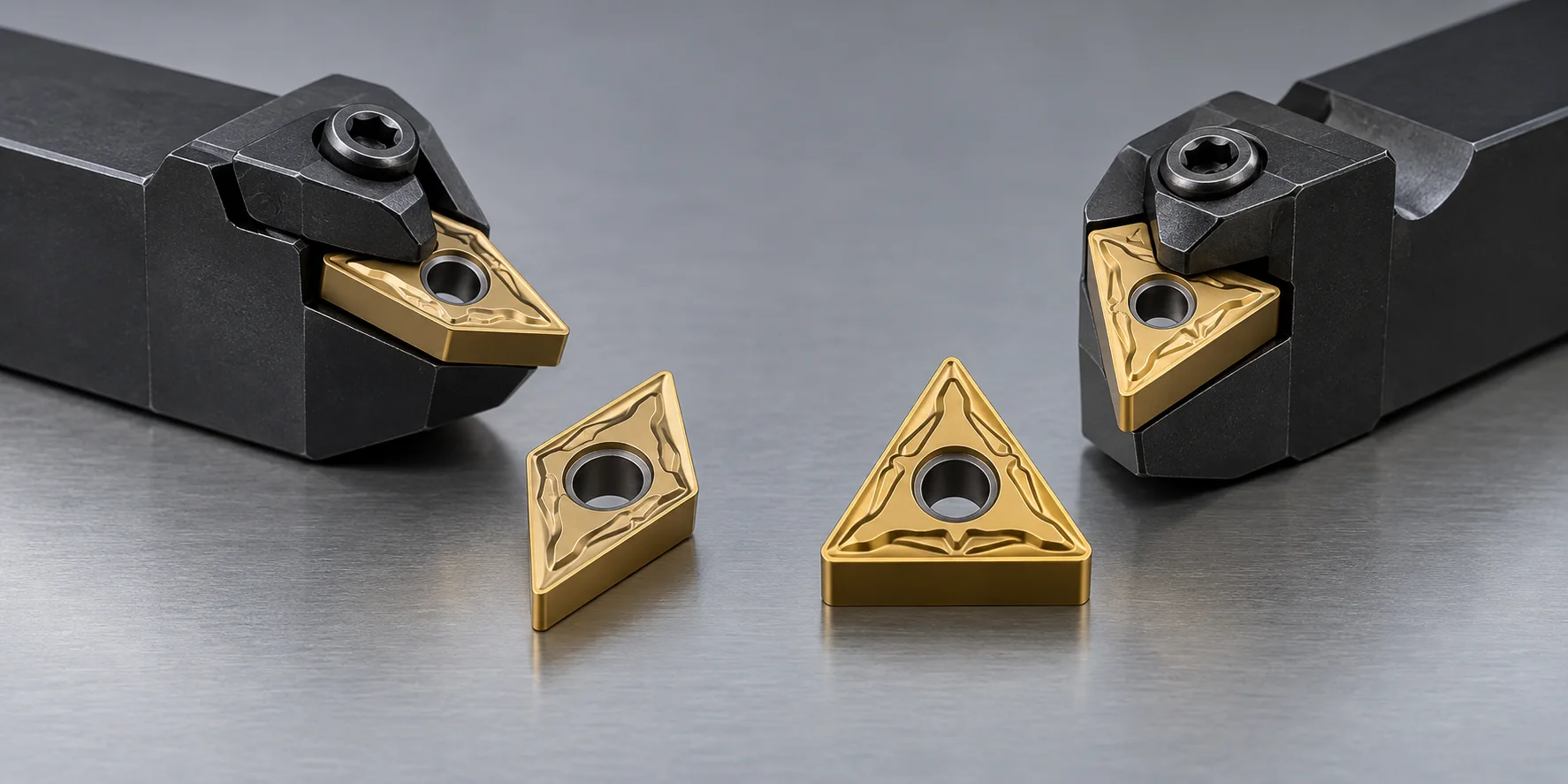
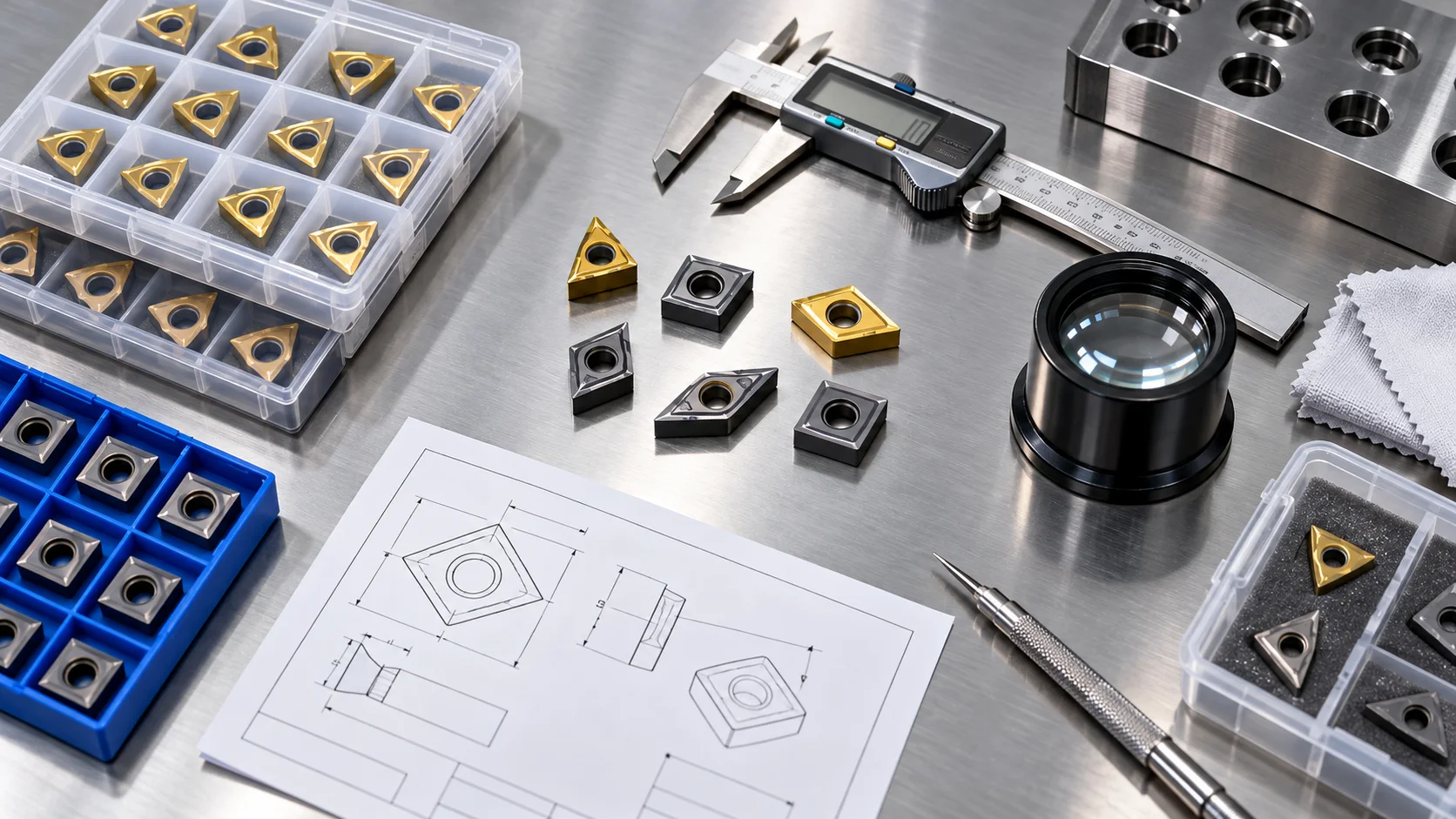
CNMG and WNMG inserts are not interchangeable. A CNMG insert is an 80-degree diamond-shaped negative insert, while a WNMG insert is an 80-degree trigon-shaped negative insert. Their shapes affect the corners available to the cut, the holder seat they require, access around the part, and how the edge is supported.
Use the holder model as your first filter. If your current holder accepts CNMG, do not order WNMG only because it appears to offer more usable corners. If your holder accepts WNMG, verify the required cutting direction and workpiece access before changing to another shape. Once compatibility is confirmed, compare the actual machining task rather than relying on a generic “better insert” claim.
Read the Complete ISO Code Before Comparing Inserts
CNMG and WNMG identify an insert family; they are not a complete purchasing specification. The full designation also identifies the insert size, thickness, tolerance, nose radius and, depending on the supplier, the chipbreaker and grade. Two inserts with the same first four letters can therefore produce very different results on the same part.
For a reliable replacement, compare the full code on the box or insert marking with the holder model. Then verify the chipbreaker, carbide grade, coating and nose radius against the workpiece material, feed and depth of cut. This prevents a common purchasing error: ordering a visually similar insert that fits poorly, controls chips badly or cannot meet the finish requirement.
What Are CNMG and WNMG Inserts?
CNMG inserts
In the ISO designation, the first letter C identifies an 80-degree diamond insert shape. The N indicates a zero-degree clearance angle, commonly described as a negative insert. CNMG inserts are double-sided and are widely used for external turning, facing, and general roughing or semi-finishing when the selected holder and chipbreaker fit the application.
WNMG inserts
The first letter W identifies a trigon insert shape. WNMG is also a negative, double-sided turning insert family. Its corner arrangement can offer a practical edge-utilization advantage in compatible setups, especially for repeat operations. However, that advantage is only meaningful when the holder, workpiece profile, clamp system, and cutting direction allow each edge to be used correctly.
CNMG vs WNMG: Side-by-Side Comparison
| Selection point | CNMG | WNMG |
|---|---|---|
| Basic shape | 80-degree diamond | 80-degree trigon |
| Insert style | Negative, double-sided family | Negative, double-sided family |
| Holder compatibility | Requires a CNMG-compatible seat and clamp system | Requires a WNMG-compatible seat and clamp system |
| Corner use | Depends on holder orientation and intended operation | Depends on holder orientation and intended operation |
| Common evaluation use | General turning, stronger edge-support requirements, variable stock conditions | Repeat operations where compatible access and edge use suit the process |
| Do not decide by | Shape photo or unit price alone | Number of nominal corners alone |
The table is a starting point, not a substitute for a catalog or application review. A complete ISO code contains more than the shape: size, thickness, nose radius, tolerance, chipbreaker style, grade, and other details can change the result significantly.
Why Holder Compatibility Comes First
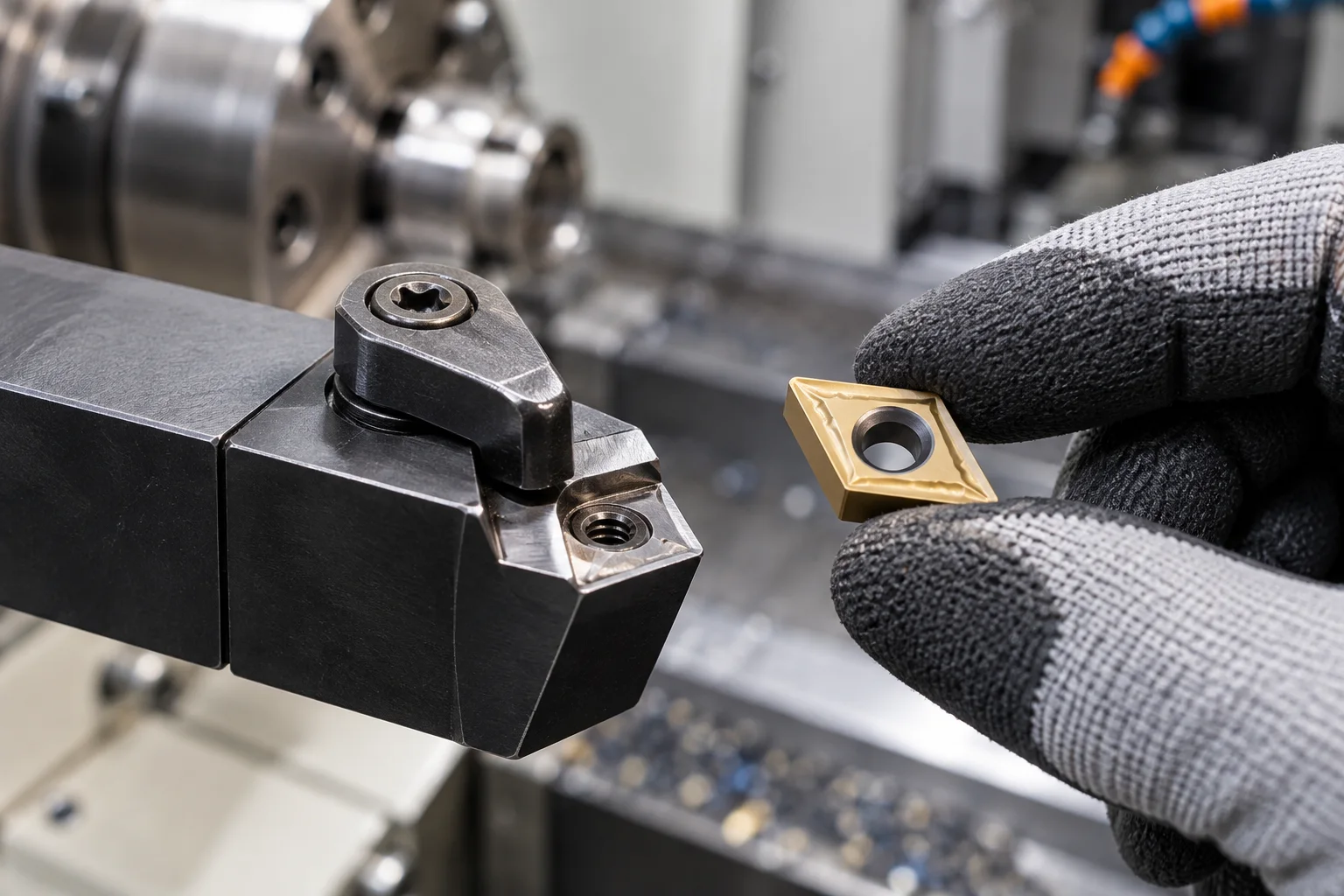
The holder controls how an insert is seated, clamped, and presented to the workpiece. A visually similar insert can still be unsuitable if the locating surfaces, center hole, clamp, or approach angle do not match. This is why a part number without a holder reference is often insufficient for a reliable replacement recommendation.
Before comparing CNMG and WNMG, inspect the marking on the holder. If the marking is unreadable, send a clear photo of the full holder and the empty insert seat. Also note whether the operation is right-hand or left-hand, external turning or facing, and whether the cut is continuous or interrupted.
| What to provide | Why it matters |
|---|---|
| Full insert code or box label | Confirms shape, size, thickness, nose radius, and geometry. |
| Holder model and insert-seat photo | Confirms the compatible insert family and clamping system. |
| Workpiece material and hardness, if known | Guides grade, coating, and edge-preparation selection. |
| Operation and cut condition | Separates roughing, finishing, facing, profiling, and interrupted cutting needs. |
| Photo of the worn edge | Helps identify chipping, flank wear, built-up edge, or thermal damage. |
How Insert Geometry Affects the Turning Operation
Geometry affects more than whether an insert fits. It influences the contact and support available at the active corner, the clearance around shoulders and profiles, the direction in which the tool can approach the part, and the way chips are formed. That is why an insert shape that performs well on an open outside diameter may be a poor match for a tight shoulder or a profile with limited access.
CNMG is commonly considered when a process needs a versatile negative insert family with robust edge support. WNMG may be considered where its compatible holder arrangement and corner access suit a repeatable operation. Neither statement overrides the actual holder, workholding, stock allowance, or machine rigidity.

When CNMG Is Usually a Better Starting Point
Start your CNMG evaluation when the current holder already uses CNMG, when the operation includes variable stock or interrupted engagement, or when your priority is a well-supported edge for general external turning. It is also a practical family to review when a job requires more than one type of turning operation and you need to compare available chipbreakers and grades within a familiar holder system.
For roughing, do not select a CNMG code only by shape. Confirm the depth of cut, feed range, material condition, scale or interrupted areas, coolant delivery, and holder overhang. Then choose a chipbreaker and grade that are intended for the load and material group. A stronger edge is useful only if the whole setup is stable enough to support it.
When WNMG May Be the Better Fit
Start your WNMG evaluation when your existing holder is designed for WNMG and the part geometry allows its intended cutting direction and corner access. It may be attractive for repeated production where the process can make practical use of its compatible corners and the buyer wants to compare cost per acceptable edge, not simply cost per insert.
Before standardizing WNMG for a production job, confirm whether the work includes shoulders, facing transitions, interruptions, or restricted profiles. Then test the selected grade and chipbreaker under documented conditions. If the test changes the holder, the cutting path, the speed, and the coolant setup at the same time, it will be difficult to know which factor caused the result.
Do Not Choose by Shape Alone
The same CNMG or WNMG shape can be supplied with different carbide substrates, coatings, edge preparations, chipbreakers, and nose radii. These details usually have a direct effect on chip control, heat, finish, and wear. For example, a continuous steel turn and an interrupted cast surface do not place the same demand on the cutting edge, even when the nominal insert size is identical.
- Grade and coating: Match the workpiece material group and machining condition.
- Chipbreaker: Match the expected depth of cut, feed, chip shape, and operation.
- Nose radius: Balance edge strength, finish, cutting force, and profile requirements.
- Edge condition: Consider sharpness versus edge support for the material and stability available.
- Clamping: Check seat condition, clamp force, and holder overhang before blaming the insert.
A Practical CNMG vs WNMG Selection Workflow
- Confirm the holder. Record its model, hand, approach angle, and clamp style. Do not assume one insert family replaces the other.
- Define the job. State the material, operation, stock condition, component profile, and whether the cut is continuous or interrupted.
- Review stability. Check machine rigidity, holder overhang, workholding, coolant delivery, and current vibration or chatter symptoms.
- Specify the insert completely. Select the compatible shape, size, nose radius, grade, chipbreaker, and any required coating.
- Run a controlled trial. Keep the same workpiece, holder, toolpath, inspection method, and wear endpoint when comparing alternatives.
During the trial, record accepted parts per edge, surface finish, chip condition, cycle time, edge wear, interruptions, and operator observations. This gives purchasing and engineering a common basis for deciding whether a change actually improves the cost per conforming part.
Match the Insert to the Workpiece and Cut Condition
CNMG and WNMG are shape families, not complete cutting solutions. The same family can perform very differently in carbon steel, stainless steel, cast iron, aluminum, or a heat-resistant alloy. The workpiece condition also matters: a clean bar, a forged skin, a casting with interruptions, and a part with a keyway do not load the cutting edge in the same way. For high-hardness workpieces, review our guide to CBN inserts vs carbide inserts before selecting a standard carbide turning insert.
For continuous steel turning, the buyer should focus on stable chip formation, predictable wear, and a geometry that works at the intended feed and depth of cut. For stainless steel, review heat, built-up edge, work-hardening behavior, coolant access, and the edge condition before changing only the insert shape. For cast iron or abrasive stock, look at grade direction, edge support, dust control, and workholding stability. These checks are more useful than copying a grade from a different machine or material.
When the operation includes an interrupted cut, an uneven allowance, or surface scale, document that fact in the inquiry. A supplier can then recommend a compatible grade and chipbreaker with the correct balance of edge strength and cutting action. If the operation is a light finishing pass on a flexible component, the tool overhang, nose radius, and cutting force may matter more than the potential number of corners on the insert.
Common Problems: What to Check Before Changing Insert Shape
| Observed problem | Do not assume | Check first |
|---|---|---|
| Corner chipping | That another insert shape alone will fix it | Interrupted engagement, edge preparation, clamping, feed, workholding, and stock condition. |
| Built-up edge | That coating is the only answer | Cutting speed, sharpness, material condition, coolant delivery, and chipbreaker range. |
| Long or tangled chips | That a more expensive grade will control chips | Depth of cut, feed, chipbreaker, nose radius, and coolant direction. |
| Poor surface finish | That a smaller nose radius is always better | Runout, vibration, workholding, edge wear, feed, and the required profile. |
| Short tool life | That nominal corner count determines cost | Wear pattern, holder rigidity, grade match, cutting data, and actual accepted parts per edge. |
Take photos before changing anything. A close image of the active corner, the chip, and the holder seat often reveals whether the problem is mechanical, application-related, or insert-related. This also makes supplier communication more efficient because the recommendation can be based on evidence rather than a shortened description such as “the insert breaks quickly.”
How to Compare Cost per Acceptable Part
Insert price is only one part of turning cost. A lower-priced insert may create more tool changes, adjustment time, scrap, or chip-handling interruptions. A higher-priced insert may not reduce total cost if it needs slower parameters or produces an unstable finish. Compare candidates using the same part material, operation, holder, toolpath, and acceptance criteria whenever practical.
A simple review can include insert cost per usable edge, parts accepted per edge, cycle time, number of tool changes, surface-finish result, scrap or rework, and operator intervention. Record the trial conditions as well. Without the same workpiece lot and cutting setup, a favorable result may be caused by a different condition rather than the insert itself.
Buyer Checklist Before Ordering in Bulk
A bulk order should be based on an approved specification rather than a shortened product name. Use this checklist before asking for a quotation:
- Full CNMG or WNMG designation, including size, thickness, nose radius, chipbreaker, and grade.
- Compatible holder model, clamp type, and right-hand or left-hand orientation.
- Workpiece material, condition, and approximate hardness when available.
- Operation: roughing, semi-finishing, finishing, facing, profiling, or interrupted cutting.
- Current problem: chipping, built-up edge, poor finish, chip tangling, vibration, or short tool life.
- Sample quantity, packaging, labeling, annual demand, and private-label requirements.
- Trial acceptance method: what measurements and wear conditions will define approval.
Frequently Asked Questions
Can a CNMG insert replace a WNMG insert in the same holder?
Usually no. Confirm the holder seat and clamp system first. Similar dimensions or a similar-looking negative insert do not prove that the insert will seat or cut correctly in the same holder.
Which insert has more usable cutting edges?
WNMG is often discussed for its corner arrangement, while CNMG can have additional corners available in certain holder arrangements. The practical answer depends on the compatible holder, cutting direction, and whether each corner is accessible for the required operation.
Is CNMG always better for roughing?
No. CNMG is a common starting point for robust general turning, but the right choice still depends on the holder, insert geometry, grade, chipbreaker, material, and setup stability.
Is WNMG only for finishing?
No. WNMG can be used in different turning tasks when the holder and process support it. Select the chipbreaker and grade for the actual load and finish target rather than treating the shape as a finishing-only rule.
What should I send when requesting a quotation?
Send the full insert code or box photo, the holder model and seat photo, workpiece material, operation, existing issue, required quantity, and packaging requirements. This gives a supplier the information needed to propose a compatible option.
How do I choose a chipbreaker for CNMG or WNMG?
Choose a chipbreaker around the material, depth of cut, feed, and whether the job is roughing, semi-finishing, or finishing. Send the intended operating range and chip problem to the supplier rather than requesting a chipbreaker by shape alone.
Should I approve a bulk order after one short trial?
For a critical or repeat production job, use a documented sample trial and repeat it enough to observe normal variation. Compare edge wear, accepted parts, finish, chip control, and cycle time under the same process conditions.
Request a CNMG or WNMG Insert Recommendation
CNMG and WNMG inserts should be selected as part of a complete turning system, not as isolated shapes. Review ZIROO TOOLS CNC turning tools and precision turning inserts when you are matching inserts with compatible holders and operations. For broader replaceable-tooling options, see our indexable cutting tools page.
If you are sourcing compatible carbide turning inserts, share your current insert code, holder model, workpiece material, operation, and any wear photos with ZIROO TOOLS. Our team can help you clarify the required specification before you move to samples or a bulk quotation.