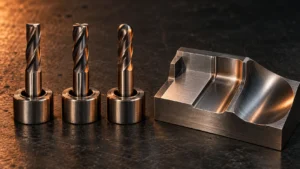
Choosing between HSS and carbide cutting tools is not a question of which material is universally better. It is a production decision. The right choice depends on workpiece material, machine rigidity, cutting stability, required tolerance, batch size, and the total cost of producing a good part.
For a short run, a repair job, or an interrupted cut on a less-rigid machine, high-speed steel (HSS) can be the safer and more economical option. For stable CNC production where speed, wear resistance, and repeatability matter, carbide often delivers a lower cost per finished part. This guide explains how to make that choice without oversimplifying either tool material.
HSS vs Carbide: The Quick Comparison
| Selection factor | HSS cutting tools | Carbide cutting tools |
|---|---|---|
| Core advantage | Toughness and forgiving behavior | Hardness, rigidity, and wear resistance |
| Best cutting environment | Lower speed, variable setup, interrupted conditions | Stable CNC setup and repeatable production |
| Heat tolerance | Lower; heat management is important | Higher; supports higher productive cutting conditions |
| Edge failure tendency | More likely to wear gradually | More likely to chip if vibration or runout is uncontrolled |
| Upfront cost | Usually lower | Usually higher |
| Economic strength | Small batches, repair, manual and flexible work | Higher volume, tighter control, reduced cycle time |
What Is High-Speed Steel (HSS)?
HSS is a family of alloy tool steels designed to retain useful hardness at elevated cutting temperatures. Common grades can contain combinations of tungsten, molybdenum, chromium, vanadium, and cobalt, but the exact composition and performance vary by grade and supplier. Its practical advantage is toughness: an HSS cutting edge can tolerate bending, vibration, and interrupted engagement better than a comparably sharp carbide edge.
This makes HSS a practical choice for drills, taps, reamers, formed tools, and some end mills where the machine or fixture is not perfectly rigid. It is also easier to regrind with conventional grinding equipment. However, when heat and abrasion rise, HSS can lose sharpness faster than carbide, so speeds and feeds must be matched to the actual operation.
What Is Carbide?
Cemented carbide is a composite material made from very hard carbide particles held in a metallic binder. The grade, grain size, binder content, coating, and edge preparation all affect how a finished tool performs. In machining, carbide is valued for high compressive strength, stiffness, hot hardness, and wear resistance.
Those properties help carbide end mills, drills, reamers, and inserts maintain geometry in demanding production work. But carbide is not automatically the correct answer. Its brittleness means that spindle runout, poor clamping, tool overhang, unstable workholding, or interrupted impact can chip the cutting edge. Carbide works best when the complete machining system is stable enough to support it.
The Most Important Differences Between HSS and Carbide
Hardness and edge retention
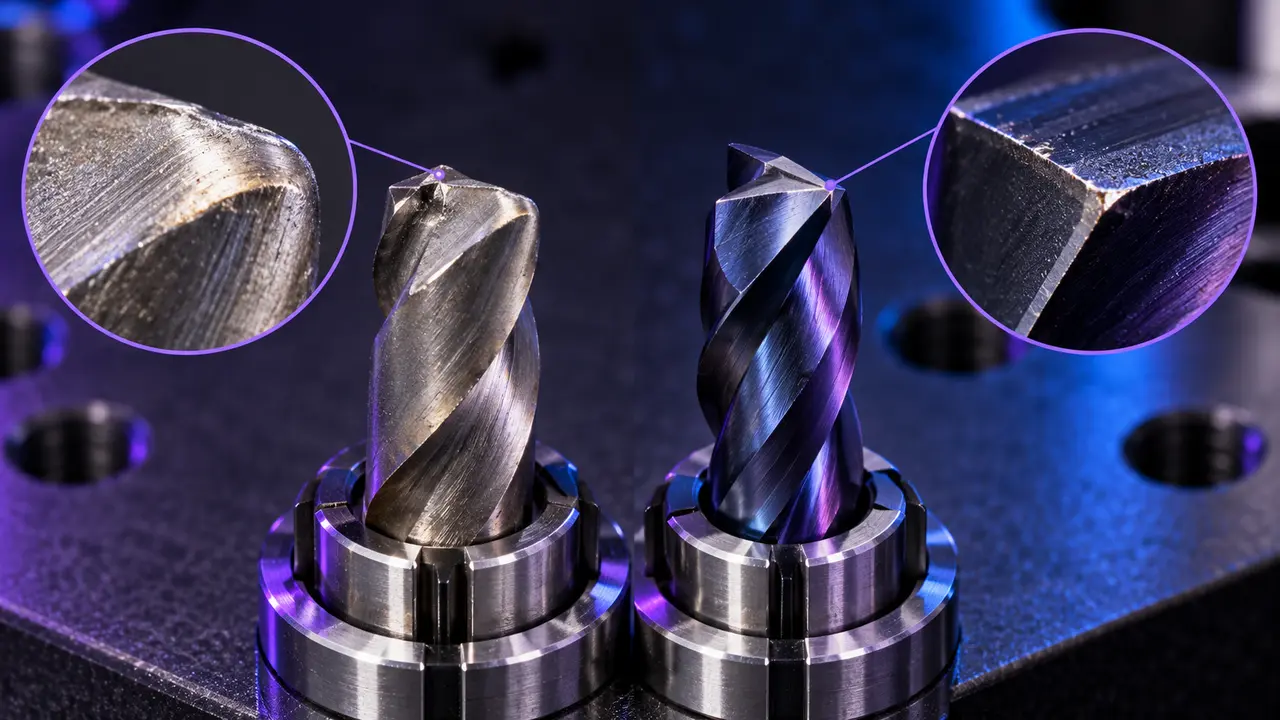
Carbide normally resists abrasive wear better than HSS. In a controlled operation, this can allow a longer interval before the tool needs to be changed, especially in alloy steels, cast iron, abrasive materials, and long CNC cycles. HSS is softer by comparison, but that softer, tougher edge is often less likely to fail suddenly when conditions are not ideal.
Toughness and vibration resistance
HSS generally absorbs shock more gracefully. Consider it when a cut is intermittent, stock varies, a feature is difficult to fixture, or an older machine has limited stiffness. Carbide can still be used in interrupted work, but it requires the right grade, edge preparation, toolholder, and cutting parameters. If chipping appears at the edge, improving stability is usually more valuable than simply switching to a harder grade.

Heat and cutting speed
Carbide retains cutting capability at higher temperatures and is commonly selected to increase cutting speed and maintain an edge during longer production runs. HSS usually needs more conservative cutting conditions to limit softening and rapid wear. The actual speed difference is application-specific; it should be set using the toolmaker’s recommendations and then adjusted from real chip formation, wear pattern, and machine behavior.
Cost per tool versus cost per part
An HSS tool may cost less to buy, which matters for prototypes, maintenance work, and low-volume orders. A carbide tool can cost more initially but pay back through shorter cycle time, fewer tool changes, more predictable dimensions, and less manual finishing. Purchasing should therefore compare cost per acceptable part, not just the unit price of the tool.
HSS vs Carbide for Common CNC Tools
Drills
HSS drills remain useful for general fabrication, manual drilling, lower-speed operations, and situations with less rigid setup. Solid carbide drills are usually considered when the operation requires stable high-output drilling, consistent hole size, difficult materials, or controlled CNC conditions. For hard workpieces, see ZIROO’s drill bits for hardened steel guide before selecting the material and geometry.
End mills
Carbide end mills are a common production choice because rigidity and wear resistance support faster milling and repeatable finishing. HSS end mills may still be suitable for lower speed, flexible, or cost-sensitive jobs. The choice should be made together with flute count, coating, radial engagement, axial depth, coolant, and tool overhang. Our carbide end mill selection guide explains the factors that matter beyond the base material.
Taps and reamers
HSS is widely used for tapping and reaming because tough cutting edges can be valuable in these sensitive operations. Carbide reamers and taps can be highly productive in a rigid, well-aligned system and for appropriate workpiece materials, but they need careful control of alignment, stock allowance, and chip evacuation. Do not choose solely by material label—select the full tool design for the hole quality and process stability required.
Saw blades and cutoff tools
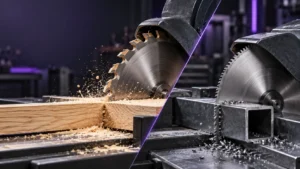
For sawing, the HSS-versus-carbide decision also depends on stock form, wall thickness, machine type, tooth geometry, and whether the cut is interrupted. For a dedicated comparison, read Carbide vs HSS Saw Blades.
Which Material Fits Your Workpiece?
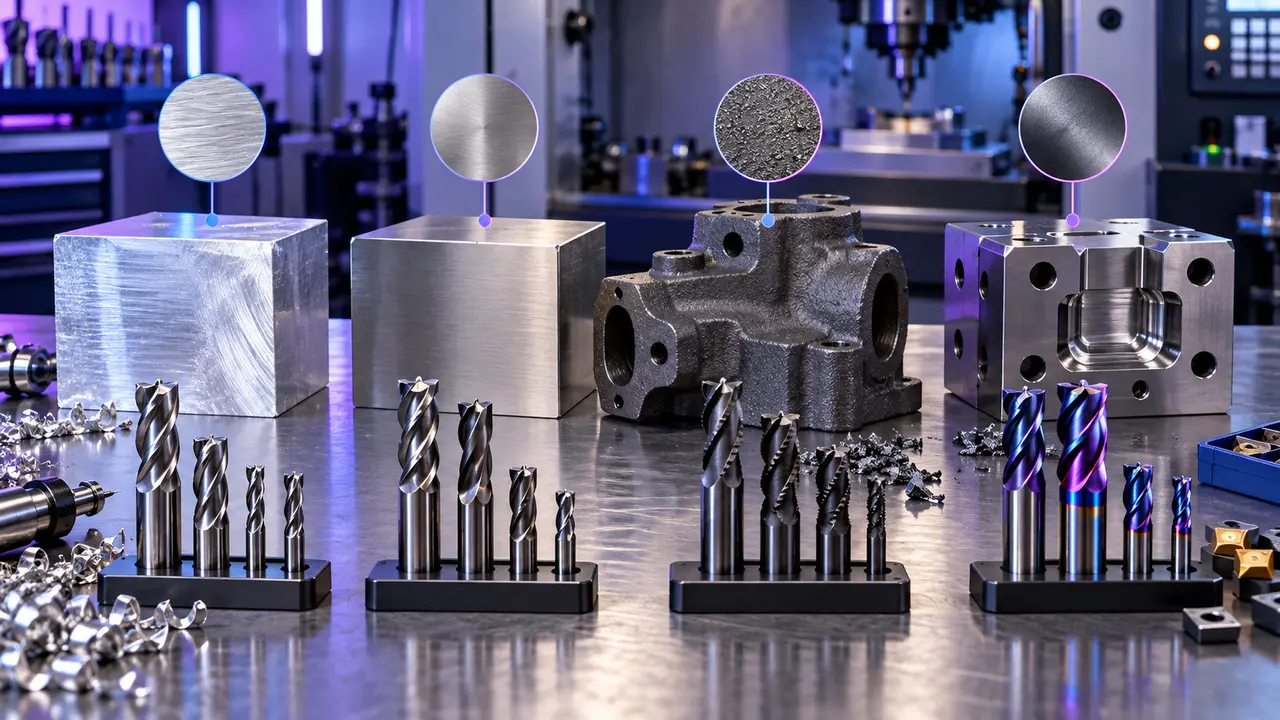
Aluminum, copper, brass, and plastics: Both HSS and carbide can work. HSS may be economical for short, low-speed work; carbide is often selected for consistent CNC throughput, especially where built-up edge and surface finish must be controlled through geometry and coating.
Mild and carbon steels: HSS can work well under moderate conditions. Carbide becomes more attractive when cycle time, consistent dimensions, and extended runs matter. The correct grade and coating must be matched to the material rather than chosen by hardness alone.
Stainless steel and heat-resistant alloys: Heat, work hardening, and adhesion demand a stable process. Carbide is frequently used for production machining, but tool geometry, coating, coolant delivery, and chip control are essential. HSS may still be sensible for particular low-speed operations where toughness is the first concern.
Cast iron and abrasive materials: Carbide’s wear resistance commonly gives it an advantage. Grade selection remains important because abrasive wear and edge chipping must be balanced.
Hardened steels: Tool selection must be based on actual workpiece hardness, operation, and machine stability. Many hardened-steel operations require a carbide solution with suitable geometry and coating; verify the full cutting application before committing to production.
Five Questions to Answer Before Choosing
- What is the workpiece material and hardness? Include material condition, not only its trade name.
- Is the cut stable or interrupted? Vibration, scale, keyways, and irregular stock can change the preferred material.
- How rigid is the machine, toolholder, fixture, and setup? Carbide performance depends on the whole system.
- What output is required? Compare prototype, small batch, repeat order, and high-volume production separately.
- What failure is most costly? A cheap tool that chips unpredictably may cost more than a higher-priced tool with controlled wear.
Common Selection Mistakes
Choosing carbide only because it is harder. Hardness does not cure runout, chatter, weak clamping, or excessive overhang. Solve the stability issue first.
Choosing HSS only because it is cheaper. When a CNC operation repeats hundreds or thousands of times, tool life, changeover time, scrap risk, and cycle time may justify carbide.
Ignoring geometry and coating. A well-matched HSS tool can outperform an incorrectly selected carbide tool. Flutes, helix, point design, edge treatment, coating, and chip evacuation all matter.
Using generic parameters without verification. The correct parameters depend on the tool, material, engagement, coolant, and machine. Start from the tooling recommendation and verify with controlled trials.
How ZIROO TOOLS Supports Tool Material Selection
ZIROO TOOLS helps B2B buyers select cutting tools around the real production requirement, not a generic material claim. For milling projects, use our milling cutter tools guide and end mill types for CNC machining overview to identify the tool family first. For mold work requiring controlled corner geometry, see corner-radius end mill selection for mold machining.
For a recommendation or OEM/ODM quotation, send the workpiece material and hardness, drawing, operation, tool dimensions, machine and holder details, coolant method, target quantity, and current machining issue. Contact ZIROO TOOLS to discuss a production-ready option.
FAQ
Is carbide always better than HSS?
No. Carbide is typically stronger in stable, higher-output machining, while HSS is often more tolerant of shock, variable setup, and low-volume work.
Can an HSS tool machine stainless steel?
It can be used for certain stainless-steel operations under suitable conditions. Select the grade, geometry, coolant, and cutting data for the application; do not assume any HSS tool is appropriate.
Why does a carbide tool chip?
Common causes include runout, chatter, unstable workholding, excessive engagement, damaged coating, poor chip evacuation, or a grade/geometry mismatch.
When does carbide usually justify its higher price?
It often justifies the investment when a stable process gains measurable value from higher throughput, longer predictable tool life, better consistency, or lower finishing effort.
Can HSS and carbide tools be resharpened?
Both can be resharpened when the tool design and remaining material allow it. The method, wheel choice, coating condition, and economics differ, so confirm feasibility with the tool supplier.
Conclusion
HSS and carbide are complementary tool materials. Choose HSS when toughness, flexibility, and lower initial cost lead the decision. Choose carbide when the CNC system is stable and productivity, heat resistance, and consistent tool life create a better result. The most reliable choice comes from the complete application—not from a material label alone.